Saving a Turn as a Test
Overview
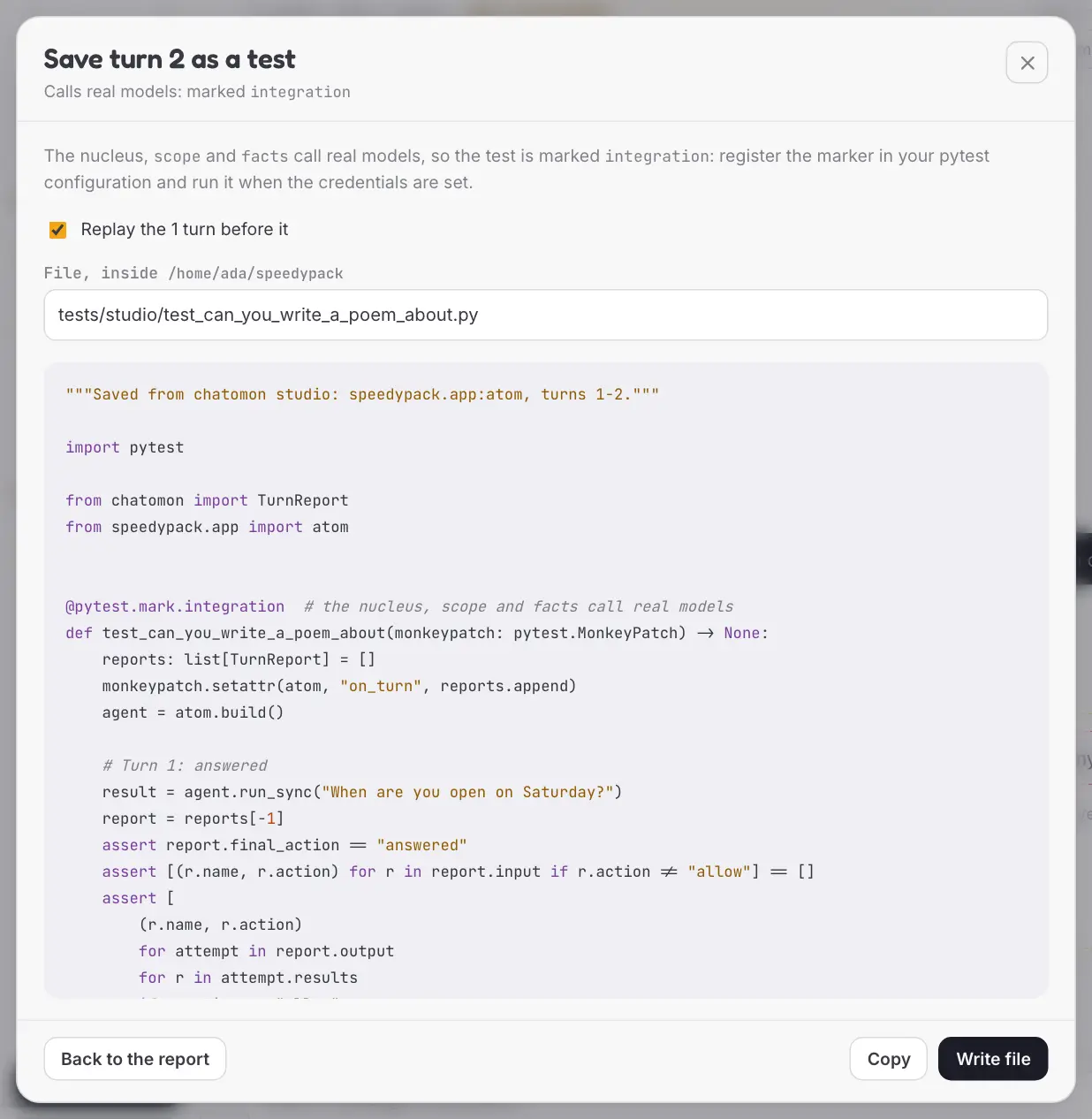
A turn you tried in the studio can become a regression test. Save as test, in the report of a turn, writes a pytest file that sends the same messages to the atom from your code and checks that each turn ends the way it did in the studio. The test runs the real atom: the nucleus and the orbitals call their own models, so most saved tests need the credentials your application needs. A turn in which an output orbital stopped a reply is the exception: in its test the nucleus repeats what it wrote in the studio, so the test can check what the orbital decides on it.
What a Test Checks
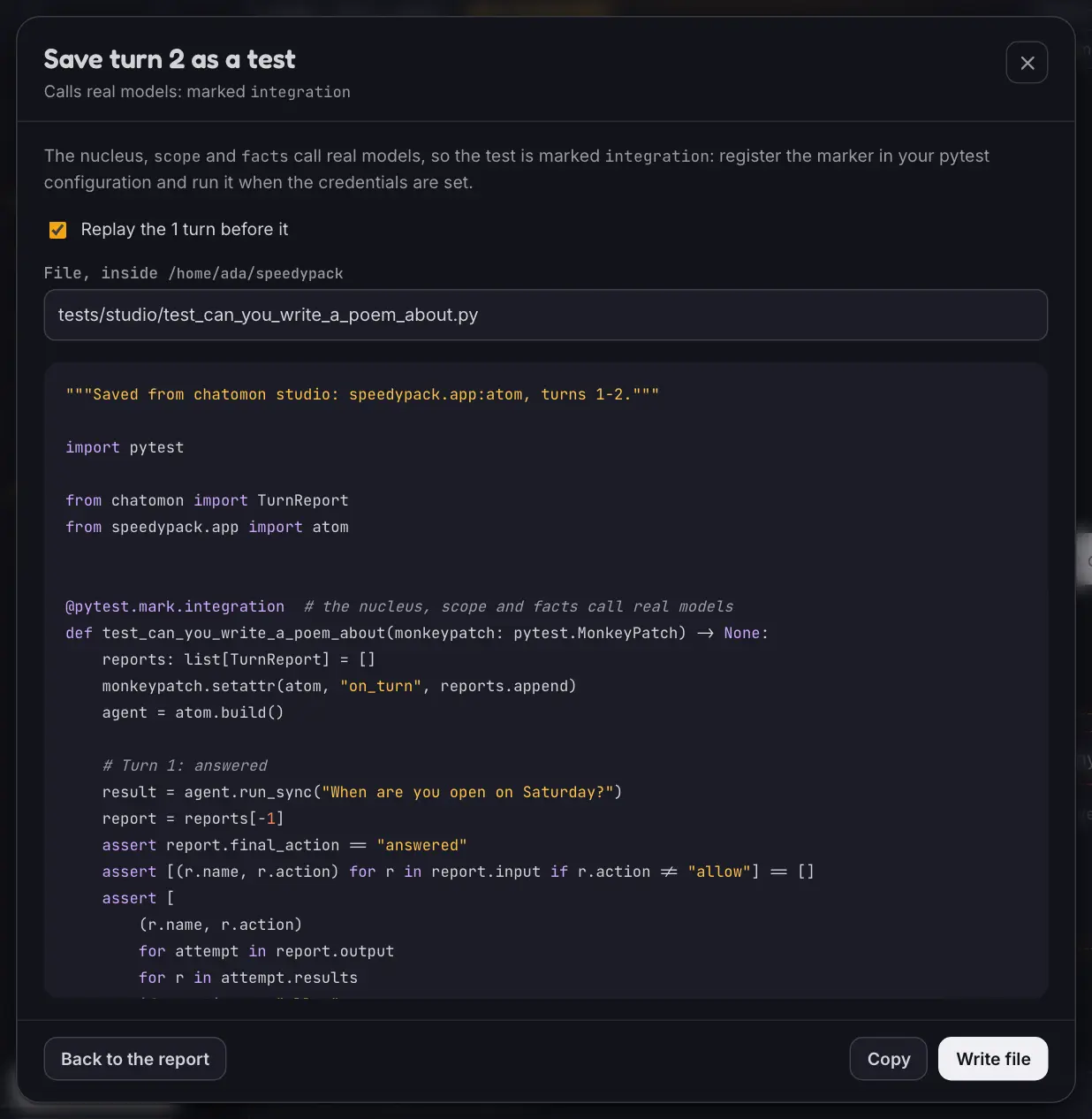
A saved test builds the atom from your code, collects its turn reports and sends one message per turn, carrying the conversation from one turn to the next. This one holds two turns: the first was answered, the second was stopped by an orbital called no_refunds.
"""Saved from chatomon studio: speedypack.app:atom, turns 1-2."""

import pytest

from chatomon import TurnReport
from speedypack.app import atom


@pytest.mark.integration  # the nucleus and scope call real models
def test_i_want_a_refund(monkeypatch: pytest.MonkeyPatch) -> None:
    reports: list[TurnReport] = []
    monkeypatch.setattr(atom, "on_turn", reports.append)
    agent = atom.build()

    # Turn 1: answered
    result = agent.run_sync("Where is my parcel?")
    report = reports[-1]
    assert report.final_action == "answered"
    assert [(r.name, r.action) for r in report.input if r.action != "allow"] == []
    assert [
        (r.name, r.action)
        for attempt in report.output
        for r in attempt.results
        if r.action != "allow"
    ] == []

    # Turn 2: blocked
    result = agent.run_sync("I want a refund", message_history=result.all_messages())
    report = reports[-1]
    assert report.final_action == "blocked"
    assert [(r.name, r.action) for r in report.input if r.action != "allow"] == [
        ("no_refunds", "block"),
    ]
    assert result.output == "We don't handle refunds in chat."
monkeypatch puts the atom back as it was when the test ends, and your own on_turn is not called while it runs. The atom keeps its capture_content: the checks need names and actions only.
| The test checks | When |
|---|---|
How the turn ended: the final_action of its report |
Always |
| The input orbitals that stopped the turn, with what they did | Always. An orbital that let the message through is not listed, so adding an orbital to your code does not break the tests you saved |
| That no output orbital stopped a reply | When none did in the studio, in any turn of the test |
| What chatomon decided on every reply of the nucleus, and the output orbitals that did not let it through | When an output orbital rejected or replaced a reply in a turn of the test: see Repeating the Replies of the Nucleus |
| The text of the reply | When the input chain produced it and no model can have written it: no orbital that calls a model ran in the turn, or the reply is the atom's refusal |
A test never checks what a model writes: a real nucleus writes something different every time. When no output orbital stopped a reply, the test expects none to. With an output judge that is close to its limit on that reply, such a test can pass one run and fail the next: the judge needs tuning, not the test.
A turn that failed cannot be saved.
Repeating the Replies of the Nucleus
When an output orbital rejects a reply, or replaces it, the turn depends on that reply having been written. A real nucleus would write something else the next time, and the orbital would have nothing to stop. So when this happened in a turn of the test, the test puts a stand-in in place of the nucleus, which repeats what the nucleus wrote in the studio, reply by reply. The orbitals run as your code defines them. This is the test of a turn in which faithfulness rejected the first reply and let the second through:
"""Saved from chatomon studio: speedypack.app:atom, turn 1."""

from collections.abc import Iterator

import pytest

from chatomon import TurnReport
from pydantic_ai.messages import ModelMessage, ModelResponse, TextPart
from pydantic_ai.models.function import AgentInfo, FunctionModel
from speedypack.app import atom

# What the nucleus wrote in the studio, in order. It is the only text a model
# wrote that this test stores: read it before you commit the file.
NUCLEUS_REPLIES = [
    # Turn 1
    "We're open Monday to Saturday, 9 to 18.",
    "We're open Monday to Friday, 9 to 18.",
]


def nucleus_replies() -> Iterator[str]:
    """Give the replies in order; the test fails if the nucleus is asked for more."""
    yield from NUCLEUS_REPLIES
    raise AssertionError("the nucleus was asked for more replies than in the studio")


def scripted_nucleus() -> FunctionModel:
    """Stand in for the nucleus: repeat its replies, call no model and no tool."""
    replies = nucleus_replies()

    def reply(messages: list[ModelMessage], info: AgentInfo) -> ModelResponse:
        return ModelResponse(parts=[TextPart(next(replies))])

    return FunctionModel(reply)


@pytest.mark.integration  # faithfulness calls a real model
def test_are_you_open_on_saturday(monkeypatch: pytest.MonkeyPatch) -> None:
    reports: list[TurnReport] = []
    monkeypatch.setattr(atom, "on_turn", reports.append)
    # The nucleus repeats what it wrote in the studio: it calls no model and no tool.
    monkeypatch.setattr(atom.connector, "model", scripted_nucleus())
    agent = atom.build()

    # Turn 1: answered
    agent.run_sync("Are you open on Saturday?")
    report = reports[-1]
    assert report.final_action == "answered"
    assert [(r.name, r.action) for r in report.input if r.action != "allow"] == []
    assert [
        (a.decision, [(r.name, r.action) for r in a.results if r.action != "allow"])
        for a in report.output
    ] == [
        ("regenerate", [("faithfulness", "block")]),
        ("accept", []),
    ]
For every reply of the nucleus, in order, the test checks what chatomon decided about it and which output orbitals did not let it through. The decisions are those of the turn report: accept, replace and regenerate, described in Observability and Audit. Take faithfulness out of your code and the first reply is accepted: the test fails and shows both lists.
| What holds | |
|---|---|
| The replies | They are what the nucleus says in the test, never what the test expects. No text a model wrote is compared: not the reply the user received, not the reason, the guidance or the reply of an orbital |
| The whole test | One turn with a stopped reply is enough: the stand-in then speaks in every turn of the test, and every turn the nucleus wrote in is checked reply by reply |
| Tools | The stand-in calls none of the atom's tools. Orbitals read messages and replies, never tool calls, so they decide on what they decided on in the studio |
| More replies than were written | When your code now rejects a reply that was accepted in the studio, the nucleus is asked for one more than it has: the test fails and says so |
| A turn asked again | When your code sent the nucleus back to write after chatomon had decided, as a LangChain middleware that jumps back to the model does, the test expects it to do so again, and the card says in which turn |
The file holds text a model wrote. A saved test has always held your messages; this one also holds the replies of the nucleus, written at the top of the file, as text, and they can quote what the nucleus read: your knowledge, or what a tool returned. The card says so before anything else. Read them before you commit the file, and edit them there if you need to: the test only needs each reply to still be one your orbitals decide on in the same way.
Clearing Replay the turns before it can change the kind of test. When the stopped reply is in an earlier turn, the last turn alone is a test with the real nucleus again.
The Test for Each Framework
The example above is the test of a PydanticAI atom. What a test checks is the same for every framework; the lines that run a turn follow the framework of the atom.
| PydanticAI | LangChain | Microsoft Agent Framework | Google ADK | |
|---|---|---|---|---|
| A turn | agent.run_sync("…") |
await agent.ainvoke({"messages": [HumanMessage("…")]}) |
await agent.run("…", session=session) |
await runner.run_debug("…", quiet=True) |
| The conversation | message_history=result.all_messages() |
The messages of the turn before go in front of the new one | A session, created once the atom is built | ADK's in-memory runner, created once the atom is built, keeps it |
| The reply | result.output |
result["messages"][-1].content |
result.text |
result[-1].content.parts[0].text |
| Offline, in place of the nucleus | TestModel |
OfflineNucleus, a chat model the test defines |
OfflineNucleus, a client the test defines |
OfflineNucleus, a model the test defines |
| Repeating the replies, in place of the nucleus | scripted_nucleus(), a function the test defines around a FunctionModel |
ScriptedNucleus, a chat model the test defines |
ScriptedNucleus, a client the test defines |
scripted_nucleus(), a function the test defines around a model of its own |
Asynchronous tests. The studio runs a LangChain agent asynchronously, Microsoft Agent Framework has no other way, and Google ADK's asynchronous run is the one it recommends, so the tests of these three frameworks are async def with @pytest.mark.asyncio(loop_scope="session") and need pytest-asyncio 0.24 or later. A LangChain test runs the agent as the studio did, which is what lets tools and middleware that are asynchronous only work in the test too. The loop is the session's because a client your module creates when it is imported keeps its connections on one loop: with a loop for each test, the second test that reaches a model would fail.
LangChain. With a checkpointer every call also takes a thread of its own, as every turn does in the studio. Offline, the test defines a chat model that takes the atom's tools and calls none, so a message your code lets through fails the test on what it expects. That stand-in replaces the model of the connector: a middleware of yours that chooses the model itself can still reach a real one, and the card says so whenever the atom has middleware. The same holds for the chat model that repeats the replies. That one is also what a middleware gets when it calls the model itself, to select tools or to summarise the conversation: it has only the replies of the turn to give, so the saved test of such an atom fails although nothing changed. The card says so whenever the atom has middleware.
Microsoft Agent Framework, an agent hosted in Foundry included. Offline, the test defines a small client and puts it on the agent it built, in place of the nucleus, so a Foundry atom never reaches its hosted agent. A test that repeats the replies does the same with a client that gives them one at a time. Both clients are written on the framework's own client classes: save the test again if they change.
Google ADK. The test builds the app, gives it to ADK's InMemoryRunner and runs every turn with run_debug, which keeps the session from one call to the next. Offline, the test defines a small model and puts it on the connector before the atom is built; a test that repeats the replies does the same with a model that gives them one at a time. The stand-in goes on the connector because the model of the built agent is chatomon's own, which runs the output chain: replacing that one would take the checks away. Both models are written on ADK's model classes: save the test again if they change. When the atom has callbacks of its own, one that calls a model can still reach a real one and one that writes the reply changes what the test sees, and the card says so. Plugins of your own run in the saved test as they do in the studio, which the card says too.
Offline means the nucleus is not called. The module of your atom is still imported, with whatever it reads when it is, and in Microsoft Agent Framework the context providers of the atom still run on a turn the input chain stops: one that calls a service calls it.
The Conversation or the Turn Alone
A turn may depend on the ones before it: a turn limit counts them, and a judge reads the history. The studio cannot tell, so a test holds the whole conversation up to the saved turn, and every turn in it is checked. When the earlier turns have nothing to do with the one you are saving, clear Replay the turns before it and the test holds that turn alone. Turns that failed are left out: they left nothing in the conversation. A turn saved alone that did depend on what came before it gives a test that fails, and the card reminds you of it.
With the real nucleus each replayed turn is a real call, so a long conversation makes a slow test. New conversation before the turn you care about keeps tests short.
Offline and Integration
A test runs offline only when no model is needed: in every turn the input chain produced the reply, and no orbital that ran calls a model. Such a test puts a stand-in in place of the nucleus: PydanticAI's test model, or for the other frameworks a small one the test defines. The nucleus then needs no credentials, the stand-in calls none of the atom's tools, and a change in your code that lets the message through fails the test instead of calling a model. The module of your atom must still import without credentials for the test to run with none.
A test in which the nucleus repeats its replies needs no model for the nucleus either. It runs offline when no orbital that ran calls a model; with one that does, such as a judge, it is the judge's own regression test: the same replies every time, and a real judge that has to decide on them as it did in the studio.
Every other test is marked integration, with a comment that names what calls real models. An orbital that connects to a service calls one, whether your code defines it or you added it in the studio; where such a test runs, the variable that holds the key must be set, because the orbital reads it when your atom is built. Register the marker in your pytest configuration, and leave these tests out where there are no credentials:
[tool.pytest.ini_options]
markers = ["integration: calls real models"]
| Command | Runs |
|---|---|
python -m pytest tests/studio |
Every saved test |
python -m pytest tests/studio -m "not integration" |
Only the tests that run offline |
Run them with python -m pytest, from the directory you start the studio in: it puts that directory on the import path, where the module of your atom is.
The studio knows whether an orbital calls a model from the orbital itself: see Saying Whether It Calls a Model. A function written with @orbital is taken as calling no model unless it says otherwise, and the card names the functions it relied on.
Changes That Are Not in Your Code
A saved test builds the atom from your code. When a turn ran with changes you made in the studio, the test describes a turn your code cannot produce yet, and it fails until those changes are in the code. The card warns about it, lists the changes each turn ran with, and opens Copy as code so you can paste the orbitals first. Saved before the code changes and passing after, the test shows that the change did what you tried. The same holds for a test that runs offline: it is offline for the turn as it ran in the studio, and until the changes are in your code, the orbitals of your code run, which may call a model.
Turns from Before a Reload
A saved test runs your code as it is now. A turn that ran before the last reload ran on the code of that moment, and the test checks what happened then. When a test holds such turns the card says which: if the code changed what they check, the test fails. Run the turn again with Re-run to see it on the code you have now.
Two more things follow from the code having changed. A test that is offline was read from what ran then: if your code now has an orbital that calls a model in front of the one that stopped the turn, the test calls it, and the card says that it may. And a turn you tried with studio changes is no longer asked to be copied into the code once your code has exactly those orbitals.
Where the File Goes
The card proposes tests/studio/test_<words of the message>.py, one file per test. The path can be changed, within these limits:
- the file stays inside the directory the studio was started from;
- its name ends in
.py, and the path does not start with~, which is not expanded; - an existing file is replaced only when the studio wrote it, and only after you confirm. Any other file is refused. The studio knows its files by their first line, so a saved test you edited by hand is replaced too, and your edits are lost.
The page chooses the turn and the path. What is written is always the test the studio generated, and the card then shows the command that runs it.
Limits
- Tools are not run when the nucleus repeats its replies. The stand-in writes the replies and calls none of the atom's tools, so such a test says nothing about them.
- A LangChain middleware that calls the model cannot work with the stand-in. A test that repeats the replies fails for an atom with one: test that atom with turns in which no output orbital stops a reply.
- Started with
serve(). The studio does not know which module the atom lives in. The card shows the test with its import left to complete, and copies it; it does not write the file. The same holds for a module whose name is not a Python name, such asmy-shop, which no import can name.
Key Components
| Component | Location | Purpose |
|---|---|---|
Orbital.calls_model |
src/chatomon/orbitals/base.py |
Whether an orbital calls a model, which decides if a test can run offline |
TurnReport |
src/chatomon/schemas.py |
The record of a turn that a saved test reads |
OutputAttempt |
src/chatomon/schemas.py |
One reply of the nucleus with what was decided about it: what a test repeats and checks |
Related Documentation
- Reading the Screen — the report of a turn, where a test is saved from
- Back to Code — Copy as code, for changes that are not in the code yet
- Frameworks in the Studio — how the studio runs the atoms of each framework
- Writing Your Own Orbital —
calls_modelfor classes and functions - Observability and Audit — the turn report and its final actions
Last Updated: October 2026 Status: Implemented